Money fights between couples are rarely about the money. They're about what feels fair. The good news is that "fair" has some math behind it, and once you both see the numbers, the conversation gets a lot easier.
The three common ways to split
- 50/50: every shared bill gets split down the middle.
- By income: each of you pays the same percentage of your pay. If you earn 60% of what the household brings home, you cover 60% of the shared bills.
- All in one pot: both paychecks go into one account and everything comes out of it.
Plenty of couples land on a mix: a joint account for shared bills, split by income, and separate money for each person to spend however they want.
What the difference looks like
Say one partner takes home $3,600 a month and the other takes home $2,400. That's $6,000 together. Shared bills, things like rent, utilities, groceries and insurance, come to $3,000 a month.
| Partner A pays | A keeps | Partner B pays | B keeps | |
|---|---|---|---|---|
| 50/50 | 1,500 | 2,100 | 1,500 | 900 |
| By income (60/40) | 1,800 | 1,800 | 1,200 | 1,200 |
Split 50/50, the shared bills take 42% of A's pay and 63% of B's. Partner A ends the month with more than twice as much left over. Split by income, the bills take exactly half of each paycheck, and each of you keeps the same share of what you earn.
Neither one is wrong. If your pay is close, 50/50 is simple and works fine. When the gap is wide, splitting by income usually feels fairer to both people, and it's easy to explain.
Running a joint account on two pay schedules
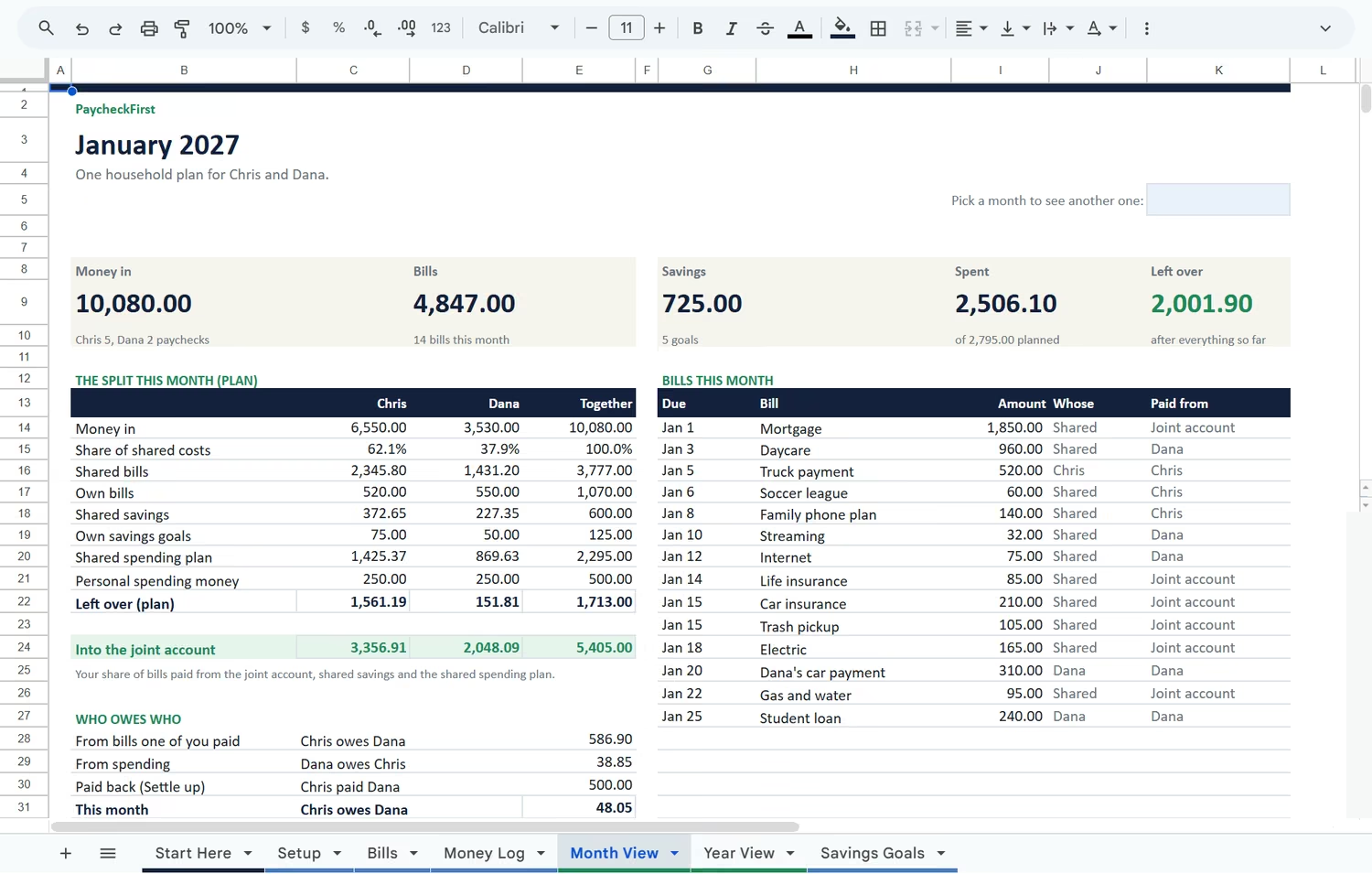
The joint account is where it gets practical, especially when you're paid on different schedules. Work out each person's monthly share, then turn it into a per-paycheck transfer:
- Partner A, paid every two weeks: $1,800 a month times 12 months is $21,600 a year. Divide by 26 paychecks and the transfer is $830.77 a check.
- Partner B, paid twice a month: $1,200 a month divided by 2 is $600 a check.
Set both transfers to run on payday. One catch: 26 checks don't divide evenly into 12 months. In a normal two-check month, A's transfers come to $1,661.54, about $138 short of $1,800. The two months with a third check make up the difference, so it all comes out even over the year. Until then, keep a cushion of several hundred dollars in the joint account so the in-between months never come up short.
Keep track of who covered what
Even with a joint account, one of you will end up paying a shared cost from your own money: a grocery run, a car repair, a kid's field trip. That's where resentment builds if nobody writes it down.
- When one of you covers a shared cost, log it.
- Keep a running balance of who owes who.
- Settle up once a month with a single transfer, and log that too.
It sounds like bookkeeping for a marriage. It's actually the opposite. When the numbers are written down, nobody has to keep score in their head.
Give each person their own money
Whatever split you pick, set aside personal spending money for each of you that the other one doesn't ask about. The same amount each, or the same percentage, whichever matches how you split the bills. It takes a lot of small arguments off the table.
Have the talk on a quiet day
Not on payday, and not right after a big purchase. Bring the numbers, agree on a split, and plan to look at it again whenever one of your incomes changes. A new job, a raise, overtime season or a slow winter all change what fair looks like.
This is general information about budgeting, not financial or legal advice.