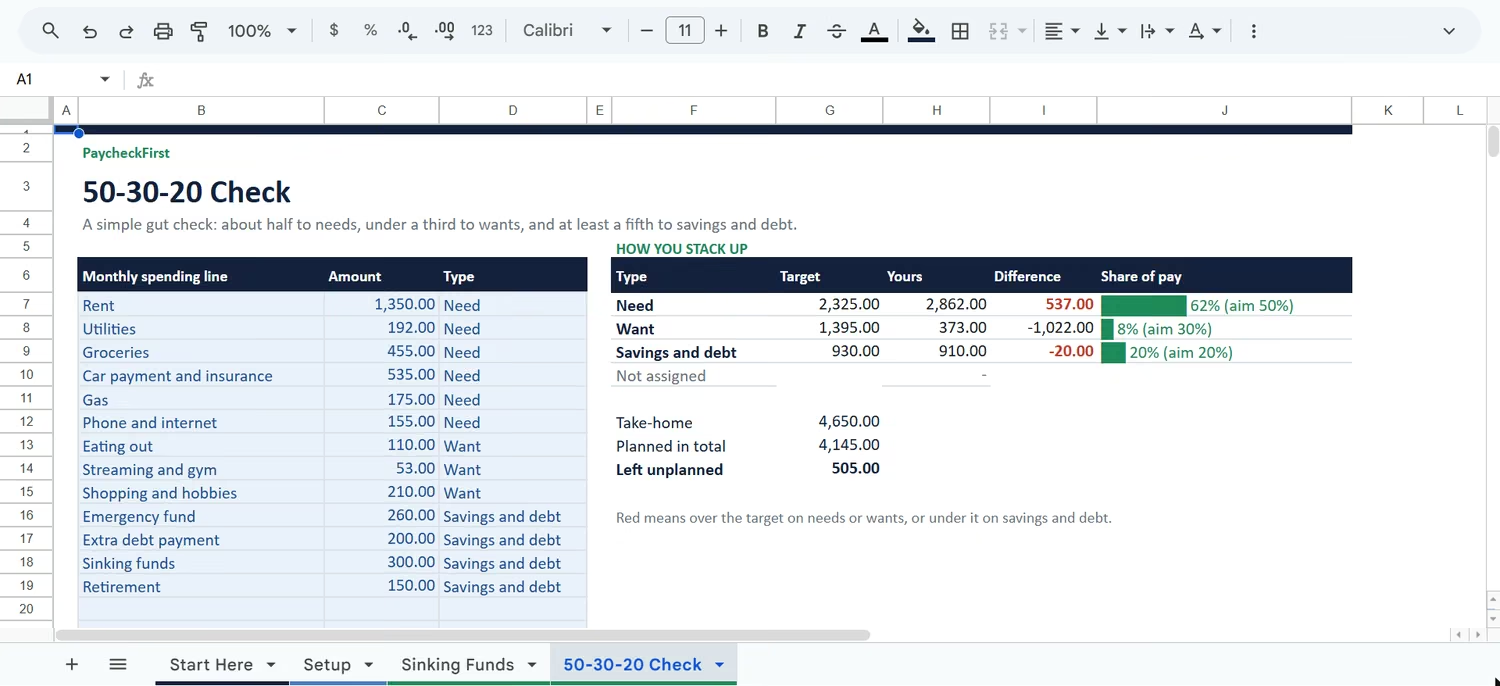
The 50/30/20 rule is the closest thing budgeting has to a level. You hold it up to your spending and see which way the bubble leans. It won't build the budget for you, but it tells you fast where the problem is.
Where the rule comes from
Elizabeth Warren and her daughter, Amelia Warren Tyagi, laid it out in their 2005 book All Your Worth: The Ultimate Lifetime Money Plan. The idea is to split your take-home pay, meaning what's left after taxes, three ways:
- 50% to needs: rent or mortgage, utilities, groceries, insurance, getting to work, and the minimum payments on your debts.
- 30% to wants: eating out, subscriptions, hobbies, shopping, trips.
- 20% to savings and debt: emergency fund, sinking funds, retirement you fund yourself, and anything you pay on debt above the minimums.
The line between a need and a want is where people fudge it. My test: if you stopped paying it tomorrow, would something you can't live without break? Groceries are a need. The takeout on a Tuesday is a want, even if it doesn't feel like one after a ten-hour day.
Running a real paycheck through it
Here's a household taking home $4,300 a month, two checks of $2,150. These are made-up numbers, but they're the kind I see all the time.
| Part | What's in it | Monthly | Share | Target |
|---|---|---|---|---|
| Needs | Rent 1,200, utilities 180, car payment 389, car insurance 146, phone 85, internet 70, groceries 400, gas 150, card minimums 80 | 2,700 | 63% | 2,150 |
| Wants | Eating out 320, subscriptions 55, gym 45, shopping 350, hobbies 200, going out 250 | 1,220 | 28% | 1,290 |
| Savings and debt | Emergency fund 200, extra on debt 100, Christmas fund 80 | 380 | 9% | 860 |
| Total | 4,300 | 100% | 4,300 |
The wants are actually under target. The savings are short by $480 a month. And the reason is right there in the first row: needs are eating 63% of the paycheck. Rent, the car payment and the car insurance alone come to $1,735, which is 40% of take-home.
What to do when your numbers don't fit
Most people who run this for the first time find needs over 50%. That's normal, especially where rent is high. The rule is a gauge, not a law. What matters is which direction you move.
- Know where the big money is. In the example, cutting all the subscriptions saves $55 a month. A car payment $150 lower saves almost three times that, every month, for years. The big wins are housing and vehicles, and they come up when a lease ends or a car gets replaced. Decide now what you'll do then.
- Move the savings number up in steps. Going from 9% to 20% overnight usually fails. Try moving $100 a month from wants to savings, live with it for a couple of months, then do it again.
- Use the extra checks. If you're paid every two weeks, two months a year bring a third check. Sending both of those to savings adds $4,300 a year in this example without touching the monthly budget.
- More hours count too. In a lot of trades, overtime is the fastest raise you can give yourself. If it's available and you want it, decide where it goes before the check shows up.
A better question than "am I at 50/30/20?"
The question I'd ask is: what's my savings rate this month, and is it higher than it was three months ago? If the answer keeps being yes, you're doing it right, whatever the percentages say.
This is general information about budgeting, not financial advice.