Most money emergencies aren't emergencies. Christmas comes every December. The car needs tires every few years. Registration, the six-month insurance premium, back-to-school, the annual subscription that renews in March. You know they're coming. They still land like a punch because they don't show up in a normal month's budget.
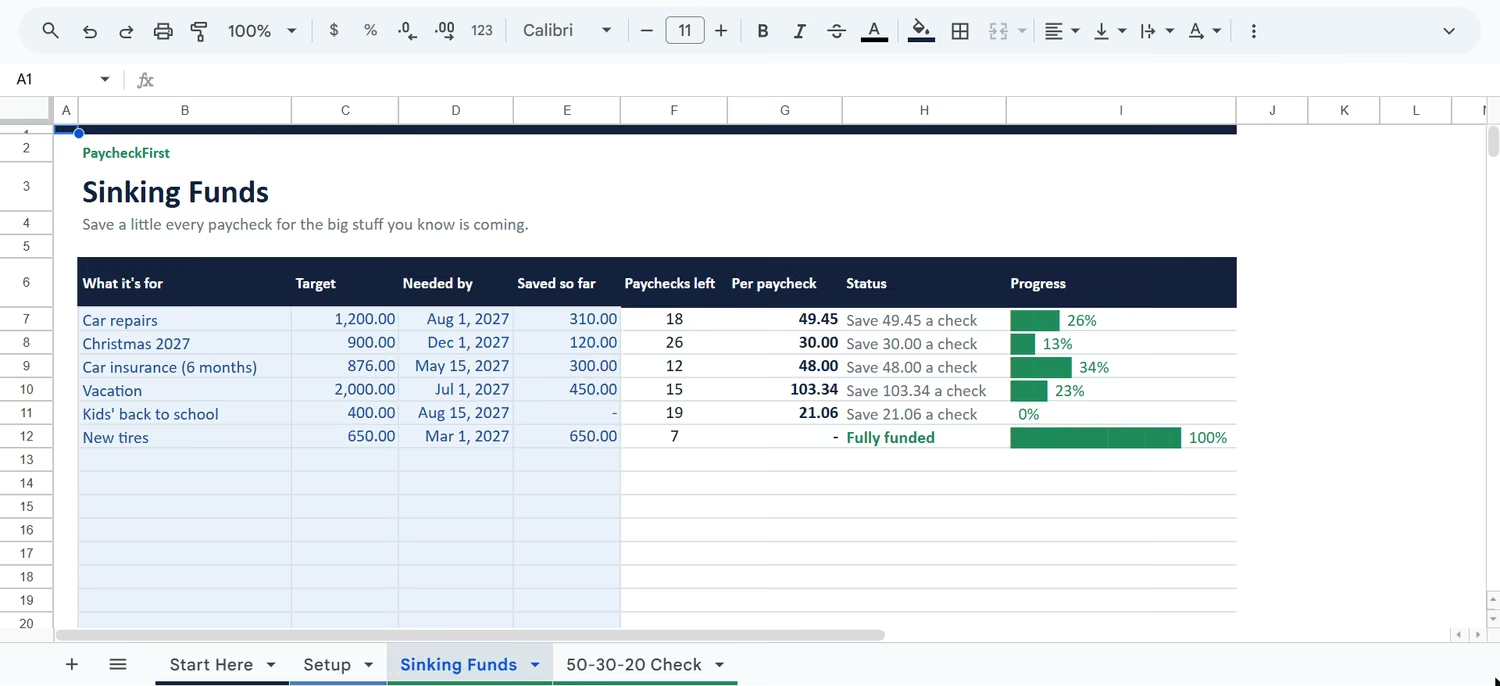
A sinking fund is money you set aside a little at a time for one of those known costs, so when the bill comes, the money is already sitting there.
Sinking fund or emergency fund?
They're different jobs.
- An emergency fund is for things you can't predict: a layoff, a medical bill, a blown transmission.
- A sinking fund is for things you can predict, at least roughly: what it costs and about when it's due.
If you only have an emergency fund, every predictable expense raids it, and it's never there when the real emergency shows up. Sinking funds keep the emergency fund for emergencies.
How much to save each paycheck
The math is one line: take the cost and divide it by the number of paychecks you have before it's due.
Here's an example for someone paid every two weeks, starting today:
| Fund | Cost | Due in | Paychecks | Per check |
|---|---|---|---|---|
| Christmas | 900.00 | 12 months | 26 | 34.62 |
| Registration and inspection | 180.00 | 6 months | 13 | 13.85 |
| New tires | 800.00 | 18 months | 39 | 20.51 |
| Work boots | 250.00 | 12 months | 26 | 9.62 |
| Total | 78.60 |
$78.60 a check feels like a lot until you compare it to finding $900 in December and $800 for tires in the same year. Spread out, it's a line item. Bunched up, it's a credit card balance.
If you're paid weekly, use 52 checks a year. Twice a month, use 24. Monthly, use 12.
Where to keep the money
Keep it out of your checking account, or it will get spent. Two setups work well:
- One savings account and a tracker. All the sinking fund money goes into one savings account, and a spreadsheet keeps track of how much of it belongs to each fund.
- Separate accounts. Some banks let you open several savings accounts or label sub-accounts. It's a little more to manage, but you can see each fund at a glance.
Either way, set the transfer to happen on payday, right after the bills. Money you never see is money you don't miss.
What to put in sinking funds
Go through last year's bank and card statements and look for anything that didn't happen every month. Common ones:
- Christmas and birthdays
- Car registration, inspection, tires, brakes and oil changes
- Insurance premiums paid every six or twelve months
- Annual subscriptions and memberships
- Back-to-school clothes and supplies
- Vet visits
- Work boots, tools and gear
- Vacation
If you're starting late
Christmas is in six weeks and you have nothing set aside. It happens. Divide what's left of the cost by the paychecks you have left, and if that number won't fit, lower the target now instead of on the 23rd. Next year, start the fund in January and the per-check amount gets small.
One more rule: if you pull money from one fund to cover another, write it down. Borrowing from the tire fund for Christmas is fine. Forgetting you did it is how you end up buying tires on a card.
The short version
- A sinking fund is for a cost you can see coming. An emergency fund is for one you can't.
- Per paycheck = the cost divided by the paychecks until it's due.
- Move the money on payday, into savings, before you can spend it.
- If you borrow between funds, write it down.