If you owe on more than one thing, you've probably heard of the debt snowball and the debt avalanche. People argue about them like it's a ballgame. The truth is less exciting: both work, both beat paying the minimums by years, and the right one is the one you'll stick with.
Here's how each one works, what the difference looks like in dollars, and how I'd decide.
What the two methods have in common
The setup is the same for both:
- List every debt with its balance, interest rate and minimum payment.
- Pay the minimum on every one of them, every month. No skipping.
- Put every extra dollar you can find on one target debt.
- When the target is paid off, take everything you were paying on it and add it to the next target. That's the roll-over, and it's what makes the payments grow as you go.
The only difference is the order you pick the targets.
- Snowball: smallest balance first, no matter the rate.
- Avalanche: highest interest rate first, no matter the balance.
A real comparison
This is the filled-in example that comes with the PaycheckFirst Debt Payoff Tracker. Six debts, $24,970 in total:
| Debt | Balance | Rate | Minimum |
|---|---|---|---|
| Store card | 640 | 29.99% | 35 |
| Medical bill | 900 | 0% | 50 |
| Mastercard | 1,180 | 19.99% | 40 |
| Personal loan | 3,200 | 11.9% | 125 |
| Visa | 4,250 | 24.99% | 110 |
| Car loan | 14,800 | 7.5% | 389 |
| Total | 24,970 | 749 |
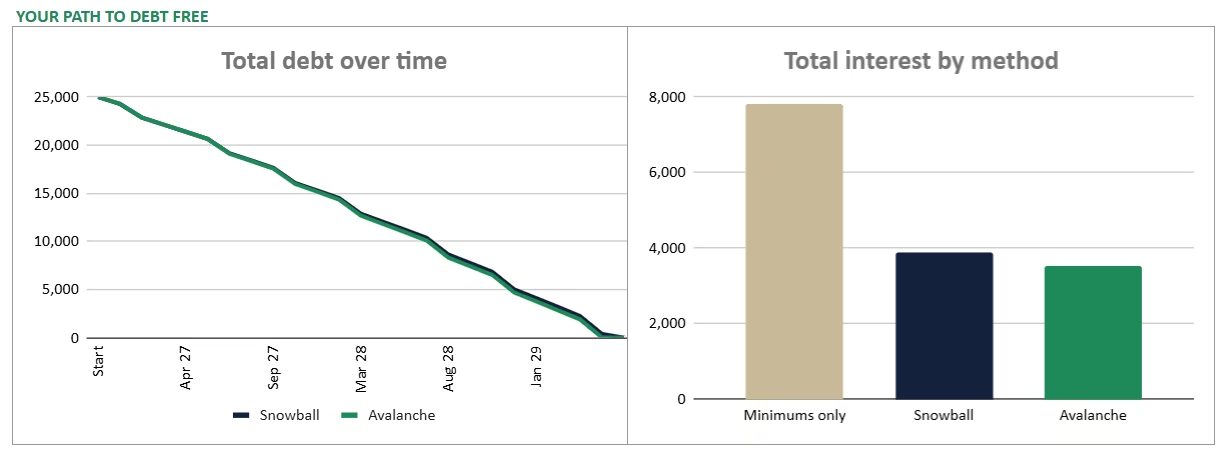
The minimums add up to $749 a month. This household adds $200 a month on top, so $949 goes to debt every month, starting December 2026. Here's what the tracker shows for each approach:
| Approach | Debt free | Months | Total interest |
|---|---|---|---|
| Minimums only, no roll-over | July 2033 | 80 | about 7,809 |
| Snowball | June 2029 | 31 | 3,889.55 |
| Avalanche | June 2029 | 31 | 3,531.87 |
A few things jump out.
Either method crushes minimums only. Both finish about four years sooner and cut the interest roughly in half. Most of that comes from the extra $200 and the roll-over, not from which order you pick.
The avalanche saved about $358 here. That's real money, but it's spread over two and a half years, and both methods finish the same month.
The snowball gets the second win sooner. Both methods knock out the store card first in this example, since it has the smallest balance and the highest rate. After that, the snowball goes after the $900 medical bill and has it paid off by May 2027. The avalanche goes after the $4,250 Visa next, so the second payoff takes a lot longer.
What the research says about motivation
The avalanche wins on paper every time, because interest is math. The case for the snowball is about people. Researchers at Northwestern's Kellogg School of Management looked at records from about 6,000 people in a debt settlement program and found that the ones who paid off small balances first were more likely to wipe out their debt completely. They published it in the Journal of Marketing Research in 2012.
That's one study of people in a settlement program, not a law of nature. But it matches what most of us know from work. A job feels a lot more doable once you've checked a few things off the list.
How I'd pick
- Run both numbers first. If the interest gap is small, like the $358 above, take the snowball and enjoy the early wins.
- Go avalanche when the gap is big. If you have one large balance at a high rate, the avalanche can save serious money, and that's worth a slower first win.
- If you've started and stalled before, go snowball. The best plan is the one you're still on a year from now.
Things that matter more than the method
- Never miss a minimum. A missed payment brings late fees, and once a payment is 30 days past due it can be reported to the credit bureaus.
- Find the extra money and protect it. Even $25 or $50 a month on top of the minimums shortens the whole plan.
- Send windfalls to the target. A tax refund, a bonus, or a month with a third paycheck goes straight on the debt you're working on.
- Know what to set aside from each check. If you get paid every two weeks, the monthly payment needs to come from somewhere. In the example above, $949 a month works out to $438 set aside from every check.
- Stop adding to the pile. Paying down a card while still charging it is like bailing a boat with the drain plug out.
Interest in the tracker is figured monthly from the rate you enter, so totals are close estimates, not your lender's exact numbers. This is general information about budgeting, not financial advice.